
Managed Evolution: Microsoft Managed Services in South Africa
Manage the Evolution, Not the Estate
Managed Evolution is a managed service that merges support and build into one team working from one governed backlog. Instead of keeping a Microsoft estate alive, it steers where that estate grows next, using live health signals, maturity scores and Microsoft change signals to decide what gets done first.
What Is Managed Evolution and How Does It Differ from Traditional Managed Services?

A traditional managed service is measured on whether the platform stayed up. Tickets are closed, SLAs are met, and the estate is handed back at the end of the month in the same condition it started. Change arrives separately, as a project, with its own team, contract, and backlog.
Managed Evolution removes that split. Support and build run as one team against one prioritised backlog, so the work that keeps the estate running and the work that moves it forward are ranked against each other rather than competing across two contracts. The estate is not held still. It is steered.
Mint Group runs this model on live enterprise estates today, including a leading South African financial services group and a listed retail and insurance group. It is contracted under the existing Mint Master Services Agreement.
Why Most Microsoft Estates Stop Moving Forward
Estates rarely fail loudly. They drift in one of three recognisable ways.
All three share one flaw. Nobody is steering where the estate grows next.
How Managed Evolution Works:
Three Layers and One Backlog
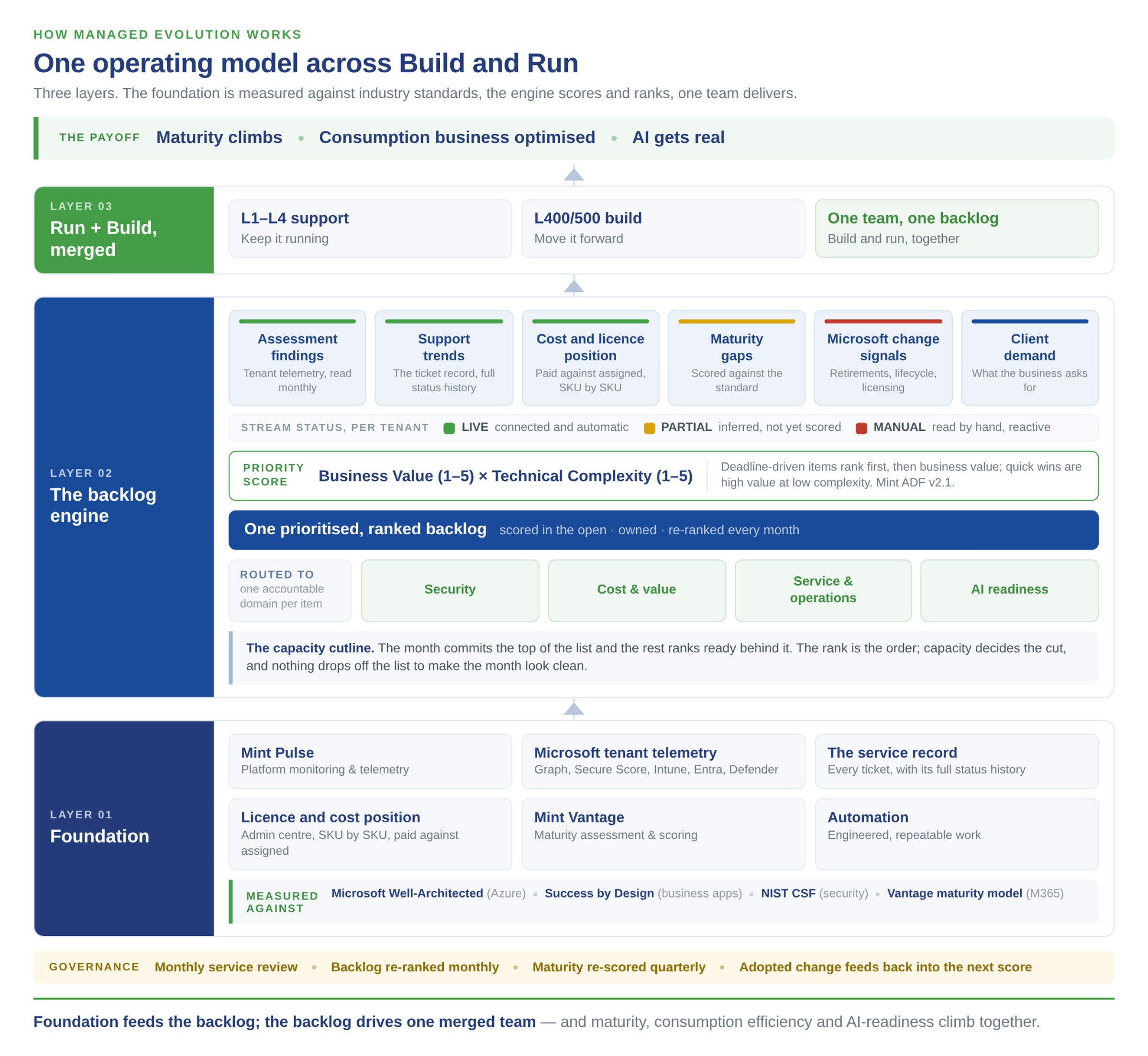
Managed Evolution runs as three layers. Each one feeds the layer above it, and the whole system is designed so nothing reaches a delivery team without being ranked first. The result is a single formula. Foundation feeds the backlog, the backlog drives one merged team, and maturity, consumption and AI-readiness climb together.
Layer 1
Foundation
Understand your estate and surface issues early.
- Monitor continuously Mint Pulse provides always-on monitoring and telemetry, surfacing problems as signals rather than annual audit findings.
- Measure maturity Mint Vantage scores Microsoft 365 maturity against a defined model.
- Automate repeatable work Engineered automation frees your team to focus on work that needs human judgement.
A clear picture of what needs attention.
Layer 2
The Backlog Engine
Turn incoming signals into one ranked backlog.
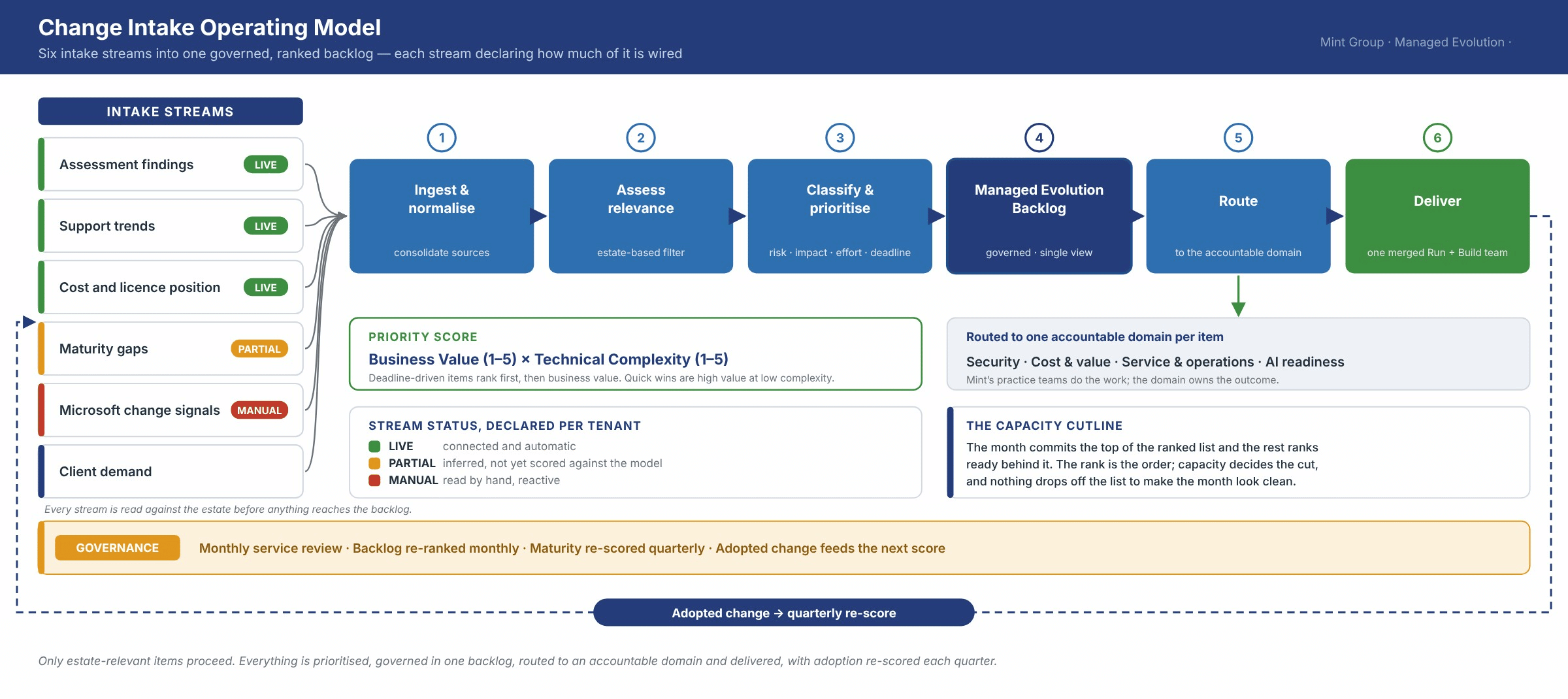
- Connect six intake streams Bring assessment findings, support trends, cost and licence position, maturity gaps, Microsoft change signals and client demand together.
- Score every item Assess risk, impact, effort and deadline before acceptance.
- Keep work relevant Only items relevant to your estate proceed.
Visible priorities. Nothing ad hoc.
Layer 3
Run & Build, Merged
One team keeps your estate running and moves it forward.
- Run your estate L1 to L4 support keeps your estate running.
- Build what’s next L400 and L500 engineering moves your estate forward.
- Share one backlog Security gaps and new capabilities are prioritised on their merits, regardless of which contract they sit under.
Priorities driven by need, across contracts.
What Feeds the Backlog
Six streams feed the backlog, and one of them is why most estates fall behind without anyone noticing.
Every stream is read against your estate before anything reaches the backlog, and each one carries a declared status in your monthly reporting: live (connected and automatic), partial (inferred, not yet scored against the model) or manual (read by hand). You always know how much of the picture is wired, and what is still being built.
Microsoft change signals is the stream almost no organisation runs deliberately. Microsoft changes Microsoft 365 and Azure continuously, and each change is either an opportunity you have not taken or a retirement that will eventually become an incident. Managed Evolution filters that stream against your actual estate, so only what is relevant reaches the backlog, and it reaches it before it becomes urgent.
From there, the pipeline is fixed. Items are ingested and normalised, assessed for relevance to your estate, classified and prioritised, admitted to the governed backlog, routed to an accountable domain owner, and delivered as either a project or a service request. Domain owners are named across Modern Work, Security and Identity, Azure, Data and Power Platform, and Business and Risk.
The Governance Rhythm
A weekly triage forum admits and ranks new items. A monthly governance review looks at what was delivered against what was promised. A quarterly maturity re-score measures whether the estate actually moved, and that score feeds straight back into the next quarter’s backlog. The loop closes, which is what makes the model a system rather than a service catalogue.
That rhythm starts from day one. See what changes in the first ninety days, from a baseline maturity score to your first quarterly re-score.
Why Businesses Trust Mint to Run and Evolve Their Microsoft Estate
Since 1999, Mint Group has delivered Microsoft Cloud solutions to South African businesses across financial services, healthcare, the public sector and more. That experience spans Microsoft 365, Dynamics 365, and Azure, which makes a single merged team across the whole estate possible.
Mint holds all six Microsoft Solution Partner designations, twelve specialisations including Copilot, Threat Protection and Identity, and more than 400 Microsoft certifications across the team. Mint is a Microsoft Business Applications Inner Circle partner, placing it in the top 1% of partners globally. A dedicated named core team owns your backlog and your relationship, with surge capacity drawn from more than 265 engineers when a Level 400 or 500 spike calls for it. You pay for peaks, not for idle benches.
Mint is B-BBEE Level 1 with 135 per cent procurement recognition, an Empowering Supplier, ISO/IEC 27001:2022 certified, and the team supporting your estate is based in South Africa.

The Backlog Is Real, Not a Concept

Most managed service provider pages describe an approach. This one can show the artefact.
On a Security, Infrastructure and Governance engagement for a listed South African financial services group, the Managed Evolution backlog was imported directly into Azure DevOps as one product, five epics, twenty-one features, forty user stories and five hundred and twenty tasks. That is 587 rows, each carrying acceptance criteria, tags, story points, iteration paths and its own original estimate, reconciled to the contracted hours before a single task was started. The structure follows Mint’s Analysis and Design Framework.
For a major South African banking group, Mint modelled twelve months of Managed Evolution as a baseline-and-re-score simulation, showing quarter by quarter where the maturity score moves and which backlog items move it. Under that engagement, the Centre of Excellence, the runbooks and the skills transfer are designed to lift the client’s own team to Level 400 and 500 capability, with Mint as the sharp end rather than a permanent dependency.
Business Benefits of Managed Evolution
Merging run and build changes what your estate does over a year, not just who answers the phone when it breaks.
One Backlog Instead of Two Contracts
Support work and improvement work are ranked against each other by risk and impact, so the important work gets done rather than whatever fits the contract with budget left.
Your Maturity Score Moves, and You Can See It
Maturity is re-scored every quarter against a defined model, so improvement is a number you can take to a board rather than an assurance from a supplier.
Microsoft Changes Reach You as Plans, Not Incidents
Retirements, advisories and new capabilities are filtered against your estate and enter the backlog early, which turns a forced migration into a scheduled one.
You Pay for Pace, Not Permanent Headcount
A committed core team holds the relationship and the backlog, and specialist capacity is drawn down only when the work needs it.
Your Own Team Gets Stronger
Runbooks, a Centre of Excellence and deliberate skills transfer are part of the engagement, so capability accumulates inside your organisation rather than only inside the supplier.
Your Estate Becomes Ready for AI
Governed identity and structured data are what Copilot and agentic AI actually run on. A backlog that steadily closes those gaps is what makes AI work when you get to it.
How Managed Evolution Is Priced
Managed Evolution is priced as outcomes with gates, not as a block of hours with extras bolted on. Each stage has a defined outcome, and the next stage opens only when that outcome is met, so you are never buying the next phase on faith.
Engagements are contracted as a service request under the existing Mint Master Services Agreement, so there is no new master contract to negotiate where one is already in place. To see what running support and projects separately costs you today, explore the Managed Evolution commercial model and request a scoped proposal.
How Mint’s Microsoft Managed Services Fit into Managed Evolution
Managed Evolution is the operating model. Mint’s existing managed services are the components that run inside it, and each one sits at a defined layer.
Why a Governed Estate Is the Precondition for AI

Microsoft 365 Copilot and agentic AI do not sit on top of your estate. They run on it. They read the same data, obey the same permissions and inherit the same problems.
An estate with inconsistent access controls gives an AI assistant access it should not have. An estate with fragmented, unlabelled data gives it very little it can use. Buying licences doesn’t solve either problem, and both are exactly the kind of work a governed backlog closes quarter by quarter while everything else keeps running.
That is why Managed Evolution and Mint’s Copilot work as one programme rather than two purchases. The maturity climbing on the dashboard is the same maturity that determines whether Copilot is useful on the day you switch it on.
Get Started with Managed Evolution
Tell us about your estate and how support and change are handled today. One of our specialists will come back to you with an assessment of where your backlog would start.
Frequently Asked Questions About Managed Evolution
What is Managed Evolution?
Managed Evolution is a Microsoft managed service model that merges support and build into one team working from a single governed backlog. Rather than keeping a Microsoft estate in its current state, it steers where that estate grows next, using live health telemetry, quarterly maturity scoring, business demand, and Microsoft’s own change signals to decide what to work on first.
Mint Group runs Managed Evolution on live enterprise estates across Microsoft 365, Azure and Dynamics 365, with a named core team and specialist capacity drawn down as the backlog requires.
Want to see where your own backlog would start? Book an assessment with our team.
How is Managed Evolution different from a traditional managed service?
A traditional managed service is measured on availability. It closes tickets, meets SLAs and returns the estate at month-end in the condition it received it. Improvement work sits outside that arrangement, as separately scoped projects with their own teams and budgets, which is why support and change so often compete instead of compounding.
Managed Evolution merges the two. Mint Group delivers support and engineering from one team against one prioritised backlog, so a security gap and a new capability are ranked against each other on risk and impact rather than by which contract they belong to.
Curious how that would change your current arrangement? Speak to our team.
What is the difference between run and build in a Microsoft estate?
Run covers the work that keeps a platform available and secure: security monitoring, incident response, patching, user support and licence administration, typically delivered at support levels one to four. Build covers the work that changes the platform: architecture, migration, integration, automation and new capability, typically delivered at levels 400 and 500 by engineers rather than support staff.
Most organisations buy these separately and discover the two teams have different priorities, different data, and different views of the same estate. Mint Group delivers both from one team and one backlog, which removes the handover between them entirely.
If run and build are pulling in different directions in your organisation, get in touch, and we will walk you through the alternative.
What is the Microsoft 365 maturity model and how does Mint use it?
A maturity model scores how well an organisation uses a platform’s capabilities, from initial and ad-hoc through to optimised, across areas such as identity, security, collaboration, data governance and adoption. Microsoft publishes a community maturity model for Microsoft 365 that gives these levels a common definition, so a score means something outside a single supplier’s opinion.
Mint Group scores your estate against a defined maturity model, converts the gaps into ranked backlog items and re-scores every quarter. Improvement becomes a measured number rather than a supplier assurance.
Not sure how your estate scores today? Ask us for a maturity assessment.
How does Managed Evolution handle Microsoft’s constant product changes?
Microsoft changes Microsoft 365 and Azure continuously through updates, retirements, security advisories, licensing changes and new features. Most organisations encounter these changes late, either as a forced migration with a deadline attached or as an incident caused by a retirement. Very few filter the change stream deliberately.
Managed Evolution treats Microsoft technologies change signals as a formal intake stream. Mint Group filters every signal against your actual estate, discards what doesn’t apply, and admits what does into the backlog early enough to plan, not absorb.
Wondering which Microsoft changes are already heading for your estate? Contact our team for a review.
Do we have to move all of our support to Mint to start?
No. Managed Evolution is designed to onboard into an existing estate and governance structure, not replace it on day one. Co-managed arrangements are common, where an internal team retains ownership of parts of the estate, and the model covers the rest, with a shared backlog visible to both sides.
Mint Group typically starts with a defined scope, proves the backlog and governance rhythm, and extends by agreement. The engagement is structured in stages with an outcome at each gate, so scope grows because it has earned the right to.
Want to talk through a starting scope? Book a conversation with our team.
How does Managed Evolution make our estate ready for AI?
Microsoft 365 Copilot and agentic AI run on your existing identity and data layer. They inherit whatever access controls, data structures, and governance already exist, which means an estate with inconsistent permissions or fragmented, unlabelled content produces disappointing AI results regardless of how many licences you buy.
Managed Evolution closes those gaps as ranked backlog work while the estate keeps running. Mint Group treats AI readiness as an outcome of governance rather than a separate purchase, which is why the maturity score and the Copilot business case move together.
Planning a Copilot rollout and unsure whether the foundation is there? Talk to our team first.
How is Managed Evolution priced?
Managed Evolution is priced as outcomes with defined gates rather than as an hourly retainer with add-ons. A committed core team is charged monthly and owns the backlog, governance, and relationship. Specialist engineering capacity is drawn from an acceleration bench against agreed outcomes, so you fund pace when you need it instead of carrying permanent headcount.
Where work qualifies, Mint Group applies Microsoft partner funding and engineering support to reduce the net cost. Engagements are contracted as a service request under an existing Mint Master Services Agreement wherever one is in place.
Ready to see what this would cost for your estate? Request a proposal.